AI support
Designing AI as an operational support layer, not a detached assistant. Designing AI as a decision layer grounded in workflow context and real product data.
Problem
Case management is operationally dense. Support reps move through complex situations quickly, often across fragmented timelines, scattered operational signals, and incomplete visibility into what actually happened. A customer waiting three days, an escalation with no owner, a blocker buried inside an internal note. The cost of a wrong decision is not abstract. It reaches the customer.
Most AI integrations do not solve this problem well. Chat interfaces require users to continuously re-explain context the system already has. Agentic systems move too fast and too opaquely, making it difficult to understand, validate, or redirect the output before a wrong recommendation becomes a wrong action. Both approaches share the same flaw: they treat AI as something separate from the workflow rather than part of it.
The challenge was not adding AI features. It was designing a support layer that could reduce cognitive load and accelerate operational understanding without introducing a new source of uncertainty.
Solution
The solution was not to replace the workflow with AI, but to embed AI into the operational model itself as a support layer for understanding, decision-making, and execution.
AI assists with interpretive tasks like summarization, risk detection, recommendations, or communication drafting, while users retain operational control and judgment. Instead of creating parallel “AI workflows” detached from the product, AI becomes part of the existing workflow structure and shared context.
To support trust and predictability, deterministic workflow signals such as ownership, SLA state, escalation status, or waiting time remain explicit and system-driven, while AI operates as an interpretive layer on top of that foundation.
The goal was not automation for its own sake, but reducing cognitive load and helping support reps move through complex cases faster and with more confidence.
How it was applied
The AI layer was designed as a set of scoped operational support systems integrated directly into the workflow. Each capability focuses on a specific operational problem while preserving explicit workflow state, visibility, and user control.
1. Creating an operational system AI can understand
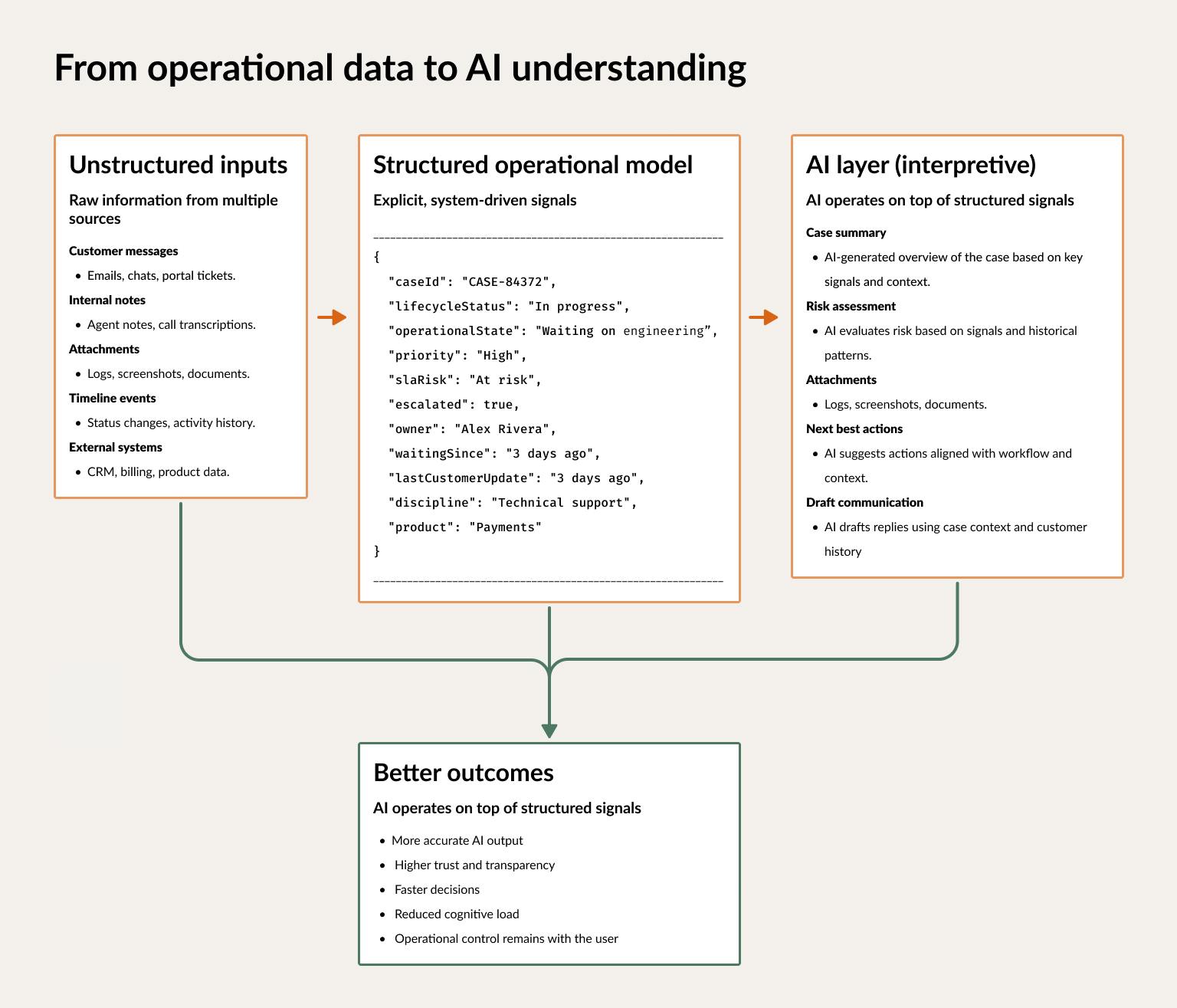
The workflow model structures operational information into explicit, system-driven signals rather than implicit knowledge spread across timelines and notes.
This creates a more reliable foundation for AI support. Instead of relying entirely on large amounts of unstructured context, AI operates on top of clearer operational signals and better-labeled information.
For example, a case can explicitly expose signals like:
Priority: High
Lifecycle status: In progress
Operational state: Waiting on engineering
SLA risk: At risk
Last customer update: 3 days ago
Escalated: True
This allows AI to reason on top of operational structure rather than trying to infer everything from raw timelines alone.
The system also separates deterministic workflow data from AI interpretation. Operational truth remains explicit and system-driven, while AI focuses on interpretive tasks like summarization, recommendations, risk detection, or communication support. This helps maintain trust, predictability, and user control while still benefiting from AI-assisted acceleration.
2. Decision panel
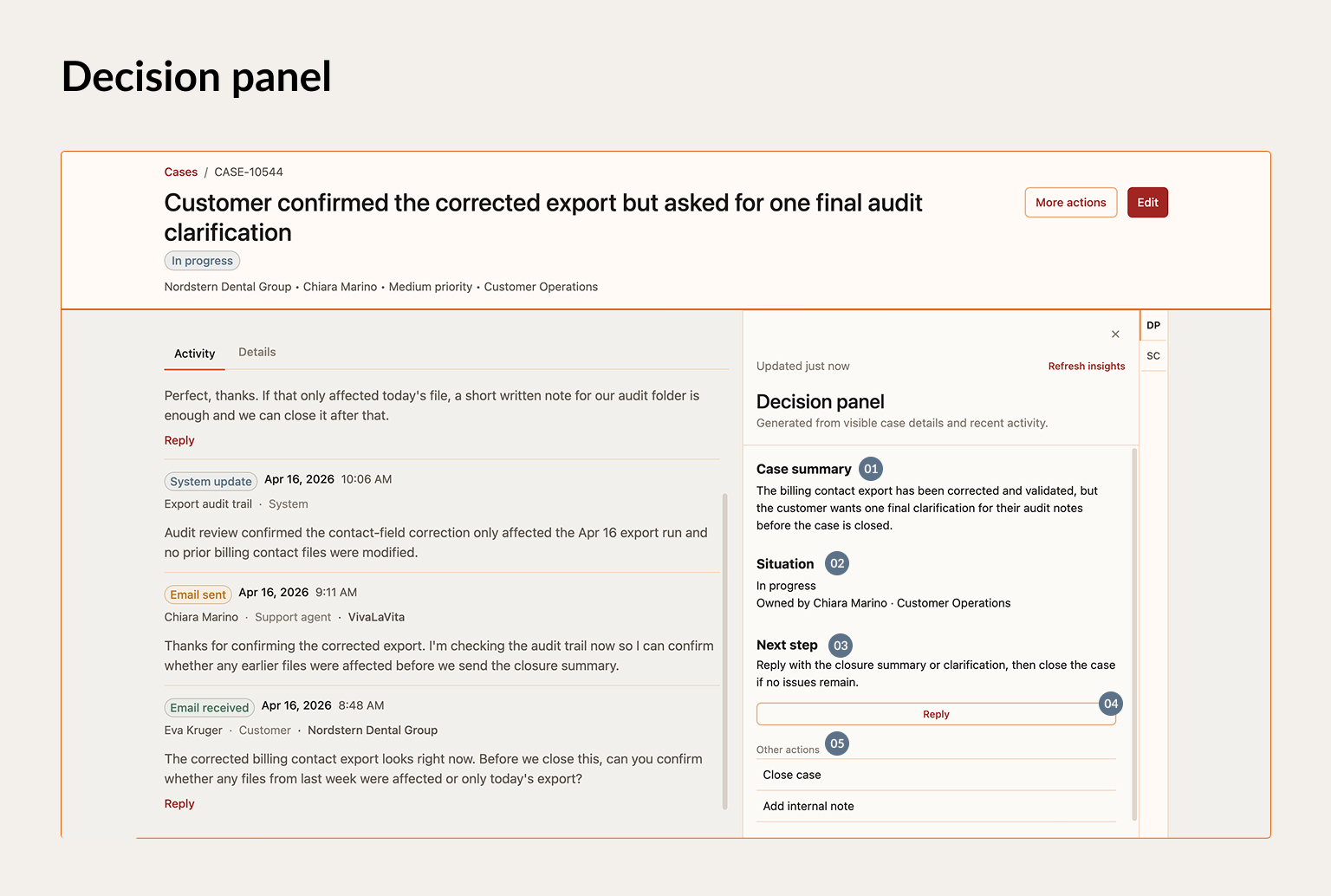
- Case summary: AI-generated overview of the case based on visible operational signals and recent activity.
- Situation: Interprets the current operational state and ownership context.
- Next step: Recommends the most likely action to move the workflow forward.
- Primary action: Allows the user to execute the recommended next step directly from the panel.
- Alternative actions: Keeps traditional workflow controls available to preserve flexibility and user control.
The decision panel acts as a focused operational support layer inside the workflow. Instead of exposing a generic assistant, AI capabilities are scoped into specific jobs with clear responsibilities: understanding the case, identifying the current situation, and recommending the next step.
This separation helps isolate failures and makes outputs easier to evaluate and trust. A summary can fail without affecting state interpretation, and recommendations can evolve independently from communication support.
The panel prioritizes clarity and control. AI helps reduce the cognitive load of understanding long timelines and fragmented context, while users still retain visibility into the operational state and full control over execution.
A primary recommended action helps move the workflow forward with confidence, but alternative actions remain available through the existing system controls. The AI layer supports operational decision-making without replacing the workflow itself.
3. Automated email replies
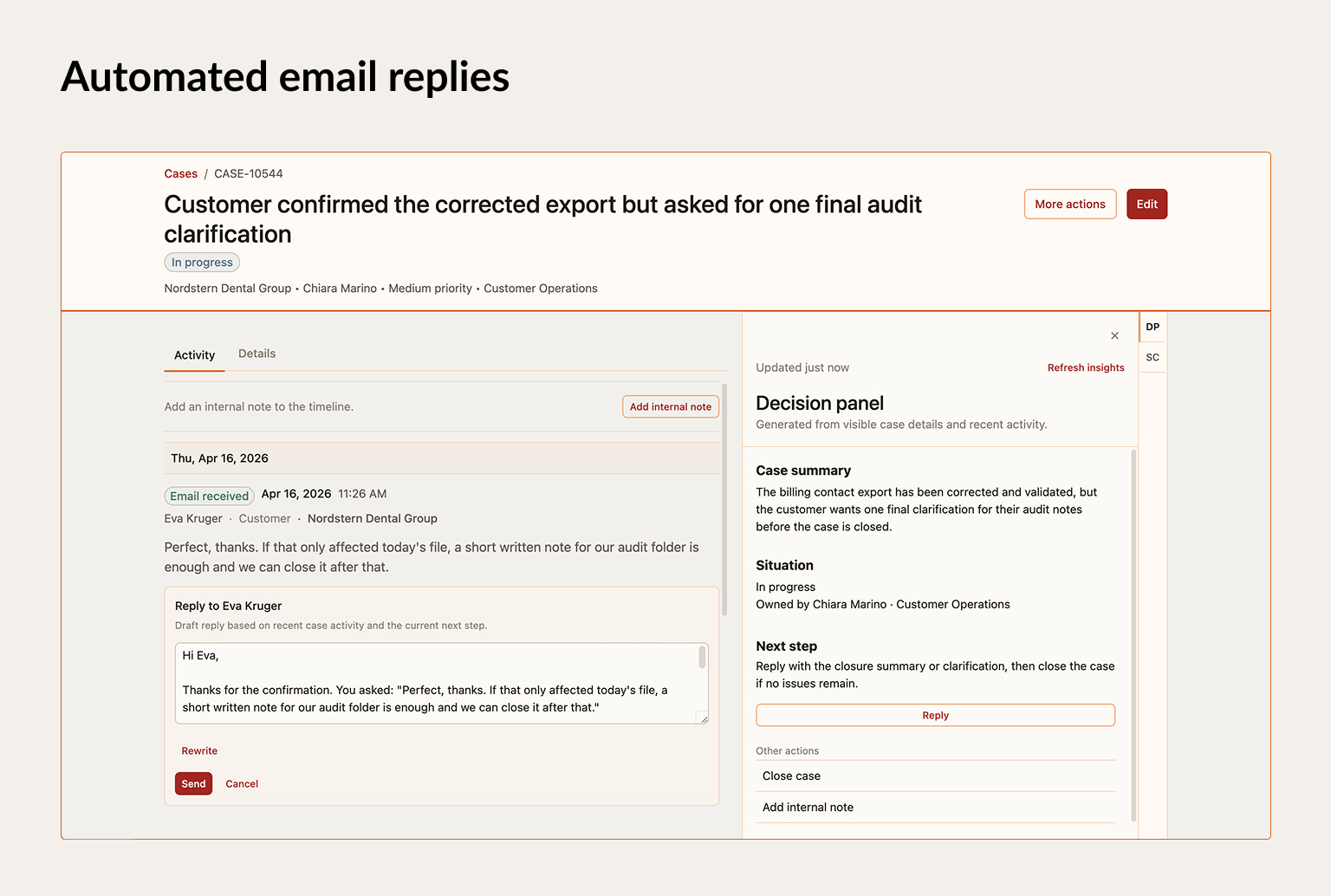
Automated replies use the same operational context that powers the decision panel. The goal is not to generate a generic response, but to help the support rep turn case understanding into clear customer communication.
Because the system already knows the case state, recent activity, blockers, and recommended next step, the draft can be grounded in shared context rather than starting from an empty prompt. This makes the reply more useful and easier to review.
The user remains in control. The generated email is presented as a draft, not an automatic action. The support rep can edit, discard, or rewrite it before sending.
This keeps AI useful in the moment where it saves real effort, while preserving judgment, accountability, and tone control with the human user.
4. AI Layer Testing Process (WIP)
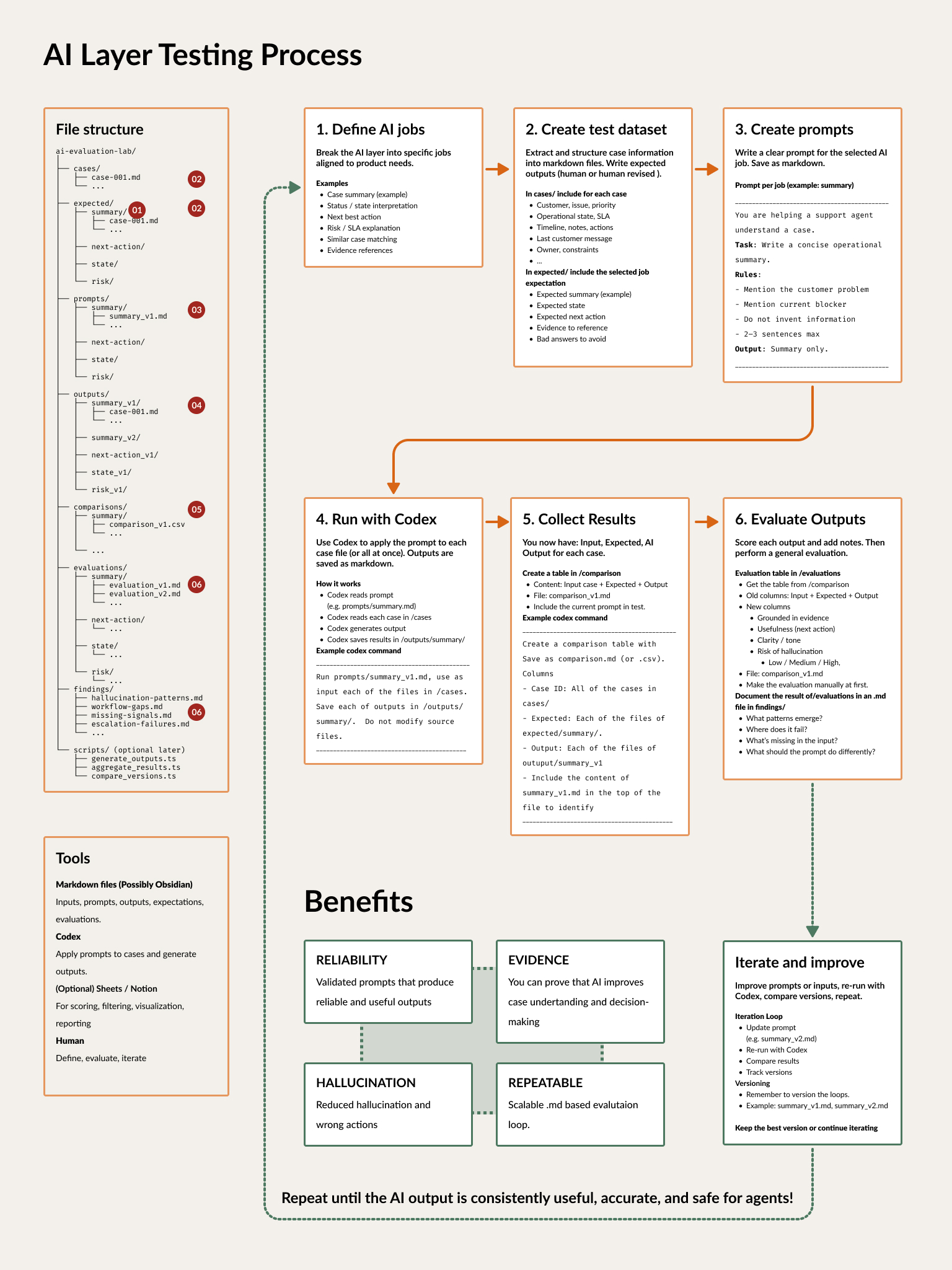
AI output is probabilistic. That is not a problem to eliminate, but a constraint to design around.
The evaluation framework treats AI outputs as operational artifacts that need to be validated, versioned, and improved over time, similarly to prompts, components, or business rules. Each AI job, summarization, situation interpretation, next-step recommendation, is tested independently against structured case files with expected outcomes defined upfront.
The process is explicit: define the job, build the dataset, write the prompt, run it through Codex, collect outputs, evaluate results, document failures, then iterate. Versioned prompts make changes inspectable over time, allowing outputs like summary_v1.md and summary_v2.md to be compared directly and evaluated against the same operational scenarios.
This matters because without explicit evaluation, prompt iteration quickly becomes intuition and guesswork. With structured evaluation loops, the AI layer can improve in a more reliable, measurable, and transparent way while also making failure patterns visible.
Tradeoff
The system intentionally prioritizes reliability, transparency, and workflow control over full automation.
AI capabilities are scoped into smaller operational jobs instead of relying on a single autonomous agent. This reduces ambiguity and makes outputs easier to evaluate and trust, but also limits the feeling of “magic” or end-to-end automation often associated with AI demos.
The approach also requires more explicit workflow modeling and structured operational signals. More effort is spent defining states, ownership, escalation logic, and evaluation processes upfront so AI can operate on clearer foundations later.
Finally, humans remain part of the decision loop. AI accelerates understanding, recommendations, and communication, but operational judgment and execution control stay with the support rep. This creates more friction than fully autonomous systems, but significantly improves predictability, inspectability, and trust.
Outcome
The result is a case management workflow where AI feels integrated into the operational experience rather than layered on top of it as a separate assistant.
Instead of relying on a generic chat interface or opaque automation, the system combines structured operational workflows with scoped AI support layers that remain understandable and controllable.
This approach helped achieve several outcomes:
- Reduced cognitive load during complex case handling by turning fragmented timelines and operational context into clearer guidance.
- Faster understanding and execution through AI-generated summaries, situation interpretation, and recommended next actions.
- Higher trust and transparency by keeping workflow state explicit and separating system-driven operational truth from AI interpretation.
- Better workflow integration by embedding AI directly into the case management experience instead of creating parallel “AI workflows”.
- More reliable iteration through structured prompts, isolated AI jobs, and explicit evaluation loops.
Beyond the prototype itself, the project also established an initial operational framework for evaluating AI usefulness, reliability, and trust over time through structured datasets, versioned prompts, generated outputs, and human review.
Next steps
The current prototype focuses on establishing the operational model, workflow structure, and trust boundaries for AI-assisted case management. The next phase would focus on improving reliability, confidence handling, and long-term evaluation.
Key areas for exploration include:
- Failure handling and uncertainty communication, especially how AI should behave when context is ambiguous, incomplete, or confidence is low.
- Expanding the evaluation framework with larger datasets, edge cases, and regression testing across prompt iterations.
- Improving explainability by making AI reasoning and referenced operational signals more visible to users.
- Refining workflow integration so AI recommendations adapt more dynamically to operational context and user behavior over time.
- Exploring how trust evolves through repeated usage, consistency, and feedback loops within real operational environments.
The long-term goal is not fully autonomous workflows, but creating AI support systems that become more reliable, understandable, and operationally useful over time.